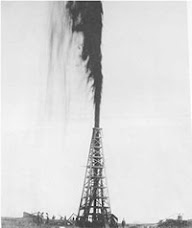
The image portrays the complex geology of its Furman-Masco leases where Arena Resources has “bet the farm.”
Arena Resources (ARD) stock closed on 1 March 2010, at $42.69 and then collapsed $7.47 to $35.22, as company released fourth results and answered questions during its conference call.
Arena Resources has never made my list of worthwhile stocks because it is not involved in any of the hot oil booms and because its founders appear to be promoters rather than real oilmen. Below is the blurb from Arena’s website on the background of these two men.
Lloyd T. (Tim) Rochford, Chairman of the Board / Co-founder For the past 35 years, Mr. Rochford has managed both public and private oil and gas operations. His expertise has resulted in the formation and ultimate sale and merger of 3 oil and gas companies, one of which was listed on the NYSE.
Stan McCabe, Director / Co-founder, For the past 29 years, Mr. McCabe has secured oil and gas leasehold interests, drilled numerous wells, and managed their operations. His expertise was critical in the formation and development of a public oil and gas operator which was listed on the NYSE.
Executive Bonuses: The oilfield is full of promoters; some of them stumble into the big time. Even blind boars find a black gold acorn once in a while. To add executive insult to stockholder injury, during the fourth quarter, Arena Resources executives paid themselves “stock based compensation” of $1.0 million when the earning of the firm were only $9.3 million. Stock compensation was 10.8% of earnings. This is in addition to regular executive compensation.
Fuhrman-Mascho Infrastructure Collapse: The Furman-Mascho is Arena Resources’ great little property where they can still drill hundreds San Andres zone, sour gas (H²S) wells per year. The Furman-Masco is Arena’s main asset; its production is 85% of ARD’s total production.
In the oil patch, infrastructure refers to items necessary to carry supplies to wells and carry production away; these include: roads and electric lines into the field, and natural gas sales pipelines and oil pipelines out of the field.
During the forth quarter of 2010, Arena Resources’ oil purchaser cut them off, its gas purchaser broke down and was down for 21 days, and its electric supply shortages worsened. Combined, these disasters cost ARD a large portion of its revenue. Arena is building a new oil sales pipeline and has already connected a number of their wells to it.
The gas-sales situation will take 18 months to rectify. Apparently, the current purchaser of this sour gas is operating old, junky, and unreliable pipelines and processing plant. The $16 million that it will cost Arena Resources to build their own gas-gathering system and plant is money well spent, but it’s like buying a gun after your store has been robbed.
Their electricity supply horror story sounds like something out of Mexico or even Zimbabwe rather than West Texas. Every time that ARD connects another well to the system, it adds one more 50 horsepower motor. In 2008 they added 221 wells and in 2009 they added 176 wells. In 2010, they will add about 300. Those 697 50-HP motors require a huge amount of electricity.
The electricity supplier’s substation is too small, and it refuses to build a bigger one. I’ve never heard of such a thing. In any event, Arena’s solution, which is probably the correct one, is to spend $4 million to build their own substation. Of course, during the 18 months it takes to build the substation Arena Resources will continue to face the brownouts (and lost production) that it has faced for the last several years. Right solution, but too late.
Bakken Boondoggle: What really burned me up about Arena Resources’ web conference was that at the end of the question and answer period, Arena Resources volunteered that they are considering entering the Bakken play.
Arena knows nothing about the Bakken, and the players already in that league include: (1) giants like ConocoPhillips (COP) that have endless cash to invest, (2) huge aggressive independents like EOG Resources, and (3) a host of smaller highly-Bakken-focused niche players like Brigham Exploration (BEXP). Entering the Bakken four years after the pros entered, would follow Arena’s pattern of being late.
Arena Resources’ Strength: ARD drills shallow San Andres zone gas wells on its Furman-Masco property for about $500K each. These wells have an “estimated ultimately recoverable” (EUR) of 28,000 equivalent barrels of oil. That’s enough to make Arena a great little company, if they stick to it. Concho Resources (CXO) follows a somewhat similar low-risk, medium-reward strategy and does quite well at it.
Present Value of Reserves: For the exciting exploration stocks that I usually cover, present value of reserves discounted at 10% (PV10) is unimportant. For a purely development firm like Arena Resources, PV10 is more important.
ARD’s market capitalization (at last night’s close of $35.22) was $1.36 B, down from $1.65 billion at the previous closing.
ARD’s reported PV10 at $38.30 per barrel of oil is $0.65 billion, and at $57.63/Bbl is $1.12 billion. PV10 calculations assume no oil price increases in the future.
With NYMEX crude selling for about $80 this morning, Arena looks interesting, as the value of the reserves – assuming no long term oil price increases – probably exceeds the price of the stock. I may buy some ARD, if it falls more. If it recovers, I’ll sell taking a trader’s profit. If it does not recover, I hold the stock.
In the long run, owning oil in the ground in Andrews County, Texas, is better that having dollars in the bank or gold buried in the garden.
-------------------------------------------------------
Miscellaneous information on Arena Resources:
The company has very little debt; it’s not going to go broke.
Insiders own only 2% of the stock; institutions own 91%.